
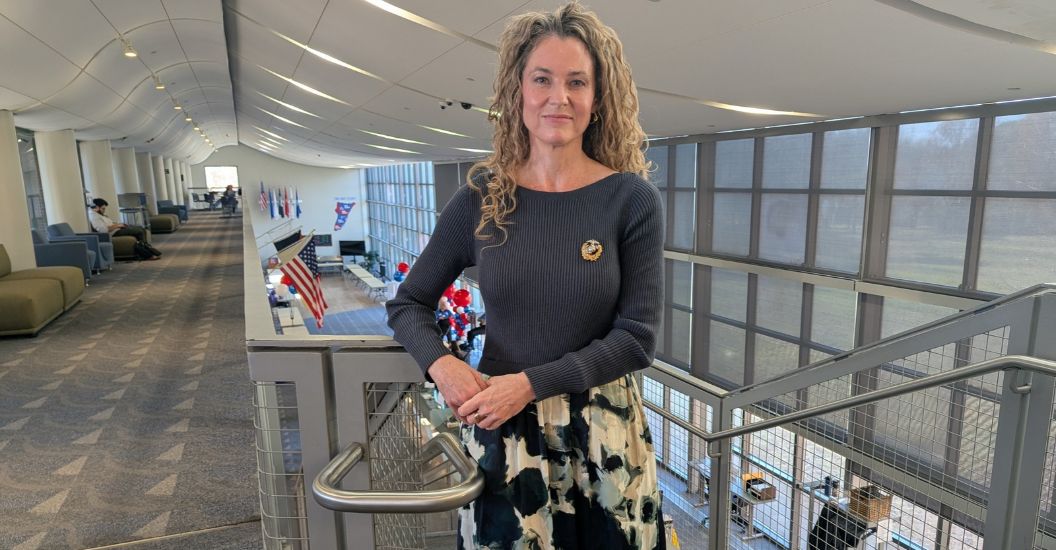
CAPE MAY COURT HOUSE – From the time she was a teenager growing up in Cape May County, Atlantic Cape Community College adjunct anatomy and physiology professor Dr. Erin Kirk was determined to change the world for the better by helping people and doing it her way.
After earning bachelor’s degrees in biology from the University of Tampa in Florida and in photography from the former University of the Arts in Philadelphia, Kirk was struggling to find the career that she desired, so she marched into the Rio Grande, NJ U.S. Marines Corps recruitment center and demanded a position as a combat photographer. After her request was repeatedly denied by her recruiters, Kirk’s persistence paid off.
Kirk, along with female military veterans Army Staff Sergeant Torie Fisher, Specialist Lucy Del Gaudio, and Petty Officer Jenna Leigh Carlton, shared their courageous stories on November 11 during New Jersey Senator Andy Kim’s Annual Veterans Town Hall at Atlantic Cape’s Cape May County campus before a lecture hall filled with attendees.
Being raised as the first girl in her family alongside two older brothers, Kirk learned early on from her mother and father to always stand up for what she wanted and believed in.
“They raised us very much to be worried and concerned about what was happening in the world and the spaces around us. They instilled that sense of wanting to serve whether as a volunteer or in the military,” said Kirk. “In high school I was very much about wanting to help people. My poor mother, I tried to drop out of high school around 15 to go to the Democratic Republic of the Congo and volunteer, but of course she did not let me, thankfully, but I think that probably is a good example of my mentality even as a young person.”
Fighting for what she wanted led her to the Marines and Kirk was obstinately determined to get the job she desired.
“I knew what job I wanted and they were going to give it to me. At the time women were still on paper not allowed to serve in combat roles. I went to those recruiters and I said I want this job (combat photographer) and they told me I couldn’t have it. I said ‘nope, I already did the research and yes I can.’ It turns out I could. They signed me up and two weeks later I was in Parris Island for boot camp,” said Kirk, who comprised less than 3% of women in the Marines while she served.
Kirk saw active duty service in the deserts of the Middle East in Iraq and Fallujah. She then transitioned her active duty status and traded in camouflage fatigues for a business suit while working in the office of the secretary of defense at the Pentagon before transitioning back to civilian life. When she speaks with young women who are considering joining the military, Kirk admits that she does not give them a recruitment speech. Instead, Kirk asks them why they want to serve, so they can choose which branch of service is best for them.
“I tell them to look at their mission, their culture, and the opportunities that are available to you throughout each and every branch. The Marine Corps isn't the Army; the Army isn't the Air Force; the Navy isn't the Coast Guard; they all have their different lived experiences,” said Kirk. “I also speak to women differently than I speak to young men. I am very frank with women about how they potentially may be treated during their service. I speak to them very frankly about how I felt at times - disrespected, unwanted, mistreated. It's a different experience for women serving in our military and it shouldn't be. So, I think having those frank conversations and preparing them for what could potentially be their experience is important to them.”
By 2016, with her military career in the rearview, Kirk was pregnant with her daughter, so she decided it was time to find a different calling. On a whim, she applied, and was accepted, into a medical doctoral program in Philadelphia. Now living in Cape May County again after giving birth to her daughter, Kirk commuted for four years to Philadelphia while completing her doctorate and to New York City for two years while working at New York University (NYU) helping military veterans suffering from opioid use disorders. Her time spent as a teaching assistant during her doctoral program was a revelation and it influenced her decision to apply to Atlantic Cape to become an adjunct professor.
“I learned pretty quickly when I was a teaching assistant (TA) through my doctorate program that what I loved about teaching was helping younger students find their way through these big medical terms and work. It's a different language, it really is,” said Kirk. “I really find it valuable that so many of our students here at Atlantic Cape are going into the medical field and they are really interested in class. They really want to understand the human anatomy and human body because they're going to be our next nurses, our next physical therapists, sonographers, radiographers. They're the pipeline of students who will be treating patients.”
As a Cape May County native, Kirk understands the needs of the surrounding communities that comprise the southernmost tip of New Jersey. From resolving transportation issues to finding adequate and affordable childcare for students, Kirk acknowledges the struggles, but sees hope for the future.
“A lot of the students that I see are older and they're trying to transition into a second career or a new career. Especially those in the nursing programs, many of them have young children and childcare can be a real problem for them to be able to reliably continue to attend classes,” said Kirk. “The facilities here are beautiful, so being able to leverage that for the people that live down here is important while also offering different times for students to attend class. I think that's really important for students to be able to still work and attend class because that’s the socioeconomic reality of Cape May County.”
If you would like to learn more about the academic programs and classes that are available at Atlantic Cape’s Cape May County campus, please visit atlanticcape.edu/capemay for more information.
###
About Atlantic Cape Community College
Established in 1964, Atlantic Cape Community College is a Middle States-accredited, Hispanic-serving institution proudly serving the residents of Atlantic and Cape May counties. As a comprehensive, two-year community college, Atlantic Cape offers more than 50 undergraduate degree programs and 34 certificate and workforce development professional series programs at its Mays Landing, Atlantic City, and Cape May campuses. Atlantic Cape is home to the renowned Academy of Culinary Arts, rated the top culinary school in New Jersey, and to its highly acclaimed Nursing program for more than 60 years. Atlantic Cape also partners with more than 30 colleges and four-year universities to offer students the opportunity to seamlessly earn a bachelor’s degree upon graduation.