

MAYS LANDING — Growing up, meeting new friends and gaining acceptance into a society that is quick to criticize is a challenge that everyone encounters throughout their adolescence. But, for individuals with disabilities the road may seem particularly arduous.
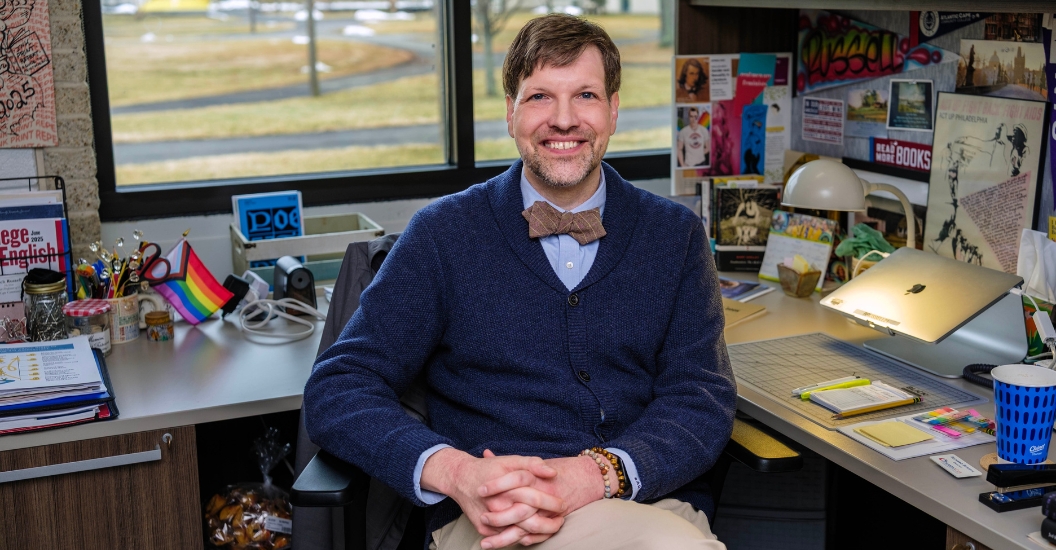
Atlantic Cape Community College American Sign Language (ASL) Professor Anthony DeFranco, who hosted a discussion and presentation on Deaf history in America from 1817 to the present on March 24 in the Innovation Center, knows firsthand the challenges of being raised a deaf person.
“As a deaf person I also grew up with autism and I had trouble making new friends with other children, especially with hearing children, in my mainstream school program because they didn’t understand any sign language or they refused to learn it. I ended up being bullied from them for miscommunication and my autistic behaviors,” said DeFranco. “My hearing mother offered a sign language class for some of the hearing children, especially in my town growing up. She would sign and teach people about myself as a Deaf person and my ability to communicate by using a sign language.”
DeFranco attended the Summit Speech School, an oral school for deaf children in Summit, NJ, until he was three years old. After transferring to Lake Drive School in Mountain Lakes, NJ, DeFranco was taught how to communicate using both Signed English and Spoken English. He attended the school’s mainstream program, which offered ASL interpreters, from 7th grade through high school.
“I used Signed English until I first learned ASL at Bergen Community College in Paramus, NJ when I took an ASL I class taught by a Deaf professor, who inspired me to become an ASL professor,” said DeFranco, who graduated in 2013 with a Bachelor’s Degree in Deaf Studies from Washington, D.C.’s Gallaudet University, which was founded in 1864 and is the world’s only university for Deaf students.
An Atlantic Cape ASL Professor since December 2023, DeFranco felt it was important to honor Deaf History Month, promote awareness and build a sense of inclusion for Deaf students in the College community.
“This is about the Deaf community, their culture and understanding their history, which shaped their community today. It is part of building awareness and acceptance toward the Deaf community because Deaf people want hearing people to understand who they are,” said DeFranco, who welcome more than a dozen staff, faculty and students to the presentation, while an ASL interpreter helped DeFranco answer questions from the speaking audience.
DeFranco currently teaches both ASL I and II classes on the Mays Landing campus on Tuesdays and Thursdays.
National Deaf History Month is celebrated annually throughout the month of April to recognize Deaf culture, history, and achievements. The month of April was chosen to mark the opening of the American School for the Deaf, the first permanent school for the Deaf in the United States, on April 15, 1817 and the founding of Gallaudet University on April 8, 1864.
Prior to being updated in 2022 by the National Association of the Deaf (NAD), National Deaf History Month was originally celebrated from March 13 – April 15 to highlight Gallaudet University’s hiring of Irving King Jordan, the University’s first Deaf president on March 13, 1988.
This event was presented by Atlantic Cape’s Center for Student Success.
About Atlantic Cape Community College
Established in 1964, Atlantic Cape Community College is a Middle States accredited, Hispanic Serving Institution proudly serving the residents of Atlantic and Cape May counties. As a comprehensive, two-year community college, Atlantic Cape offers 47 undergraduate degree programs, and 34 certificate and professional series programs at its Mays Landing, Atlantic City and Cape May County campuses. Atlantic Cape is home to the renowned Academy of Culinary Arts, rated the top culinary school in New Jersey, and for more than 50 years, our highly-acclaimed Nursing program. Atlantic Cape also partners with more than 30 colleges and four-year universities to offer students the opportunity to seamlessly earn a bachelor’s degree upon graduation.