
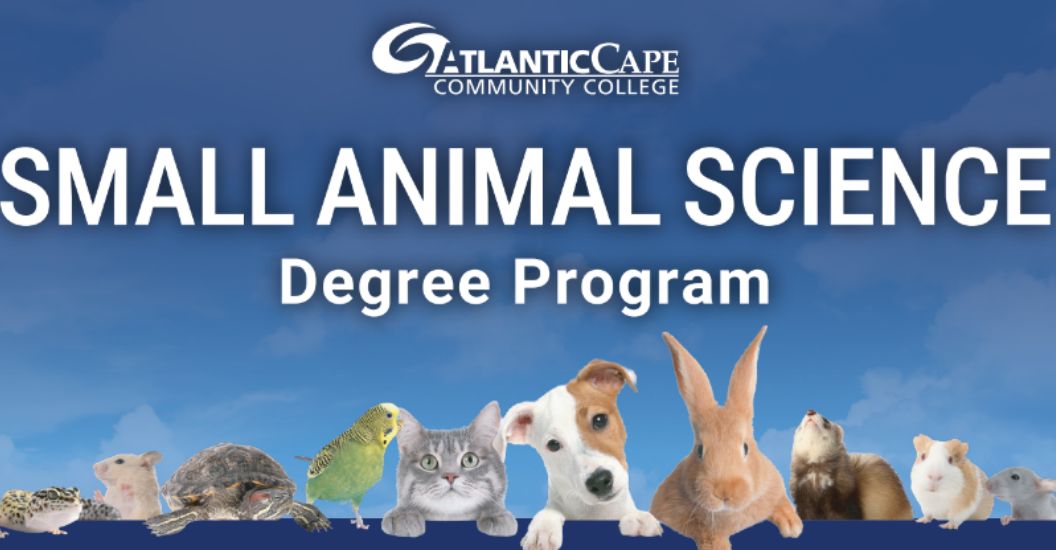
MAYS LANDING – Atlantic Cape Community College’s Associate in Science Small Animal Science degree program at the Cape May County campus offers students the opportunity to acquire foundational knowledge of animal care and management through proven methods that prepares them for worthwhile careers in animal health, welfare and sciences.
Students who choose this academic pathway will have the option to complete nearly all of the required general education and program courses either in–person or hybrid at the Cape May County campus. During the upcoming Spring Semester, the Biology 107, Biology 109, Biology 250 and Chemistry 110 classes will be offered in Cape May either in–person or hybrid online. Students may register for the Winter and Spring semesters now by visiting atlanticcape.edu/register.
“I am extremely excited to see the Small Animal Science program become part of Atlantic Cape’s academic offerings. We have created a program that lets students turn their interest in animals into a rigorous scientific education. Students will study anatomy and physiology, genetics, microbiology, nutrition, animal health, ethics, and welfare while gaining hands-on laboratory experience that connects scientific concepts with practical applications,” said Assistant Professor of Biology Dr. Christopher Carbone.
This program will allow students, once they earn their associate degree from Atlantic Cape, to transfer to a four–year college or university in various academic pathways.
“One of the program's greatest strengths is the options it offers students. It provides a strong foundation for transfer into a four-year animal science, pre-veterinary, biological science, or related program while also exposing students to career pathways in animal health, welfare, research, agriculture, animal management, and companion-animal industries.”
Carbone’s goal has been to build a program where students do more than learn how to care for animals.
“In this program, students learn the science behind animal health and well-being. I want our graduates to leave Atlantic Cape able to think scientifically, solve problems, and use evidence to make informed decisions about animals and their care.”
Interim Dean STEM and Professor of Biology Dr. Jolie Master touched on the various career options that students will be able to pursue following their studies.
“This program was designed for students who are interested in careers with animals, and not necessarily only veterinary science. While a student who wants to pursue a career as a veterinarian could absolutely graduate with this program before moving to a four year biology/pre-veterinary degree, there are also many more career options available that this program could lead to. Fields of study vary from direct animal care and behavior studies to industries such as nutrition and food sciences, livestock and agriculture, conservation and research,” said Master.
For more information on the Small Animal Science program, please visit catalog.atlantic.edu/small-animal-science/small-animal-science.
###
About Atlantic Cape Community College
Established in 1964, Atlantic Cape Community College is a Middle States-accredited, Hispanic-serving institution proudly serving the residents of Atlantic and Cape May counties. As a comprehensive, two-year community college, Atlantic Cape offers more than 50 undergraduate degree programs and 33 certificate and workforce development professional series programs at its Mays Landing, Atlantic City, and Cape May campuses. Atlantic Cape is home to the renowned Academy of Culinary Arts, rated the top culinary school in New Jersey, and to its highly acclaimed Nursing program for more than 60 years. Atlantic Cape also partners with more than 30 colleges and four-year universities to offer students the opportunity to seamlessly earn a bachelor’s degree upon graduation.