
MAYS LANDING – Brendan Connell of Linwood has personally witnessed how the technological prowess and untapped potential of artificial intelligence (A.I.), for both good and ill, can have an affect on the livelihoods of today’s blue–collar and white–collar professionals, and the global business world as a whole.
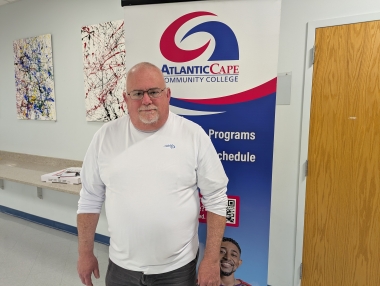 For 42 years, Connell was a district manager for an in–home repair service company in Philadelphia. Most recently he was part of a group of technicians developing an advanced technology that ultimately would end his career.
“About eight months before I was ready to retire, we started building a data set for A.I. so that our field technicians would text in, text a bot and then the bot would answer them. However, we as technicians had to answer for the bot and then about three weeks before I was set to retire, they let the entire field team go. I was replaced by A.I.,” said Connell, whose daughter will be studying business at Atlantic Cape starting in the fall.
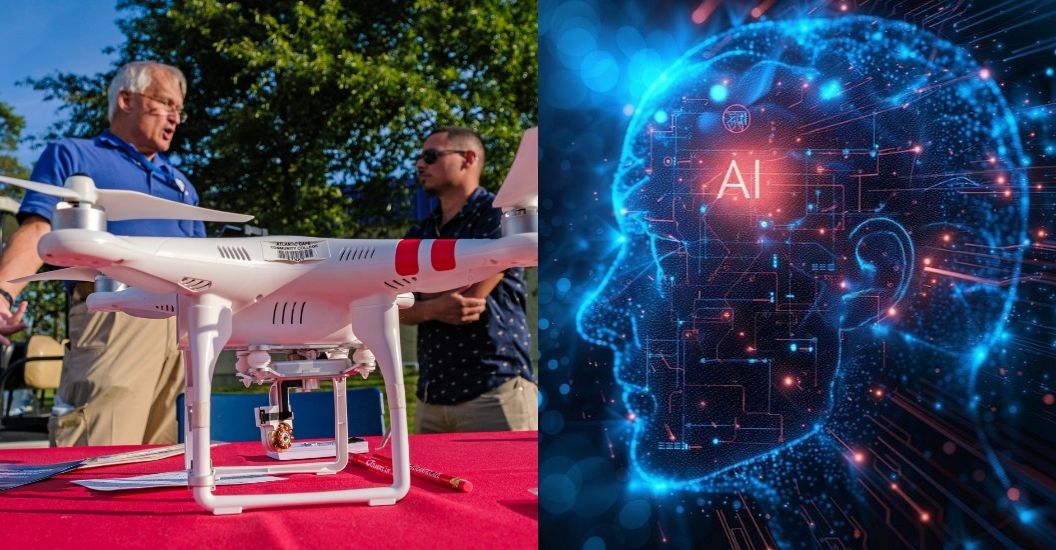
While one may naturally be bitter about being pushed aside by a burgeoning technology such as A.I., Connell was intrigued and interested enough by it to attend Atlantic Cape Community College’s A.I. and Drone Information Session on April 23 at the Mays Landing campus.
“I have an interest in A.I. I want to try to put something together to help small businesses with operations and point–of–sale systems, and A.I. is going to be a big part of that,” said Connell.
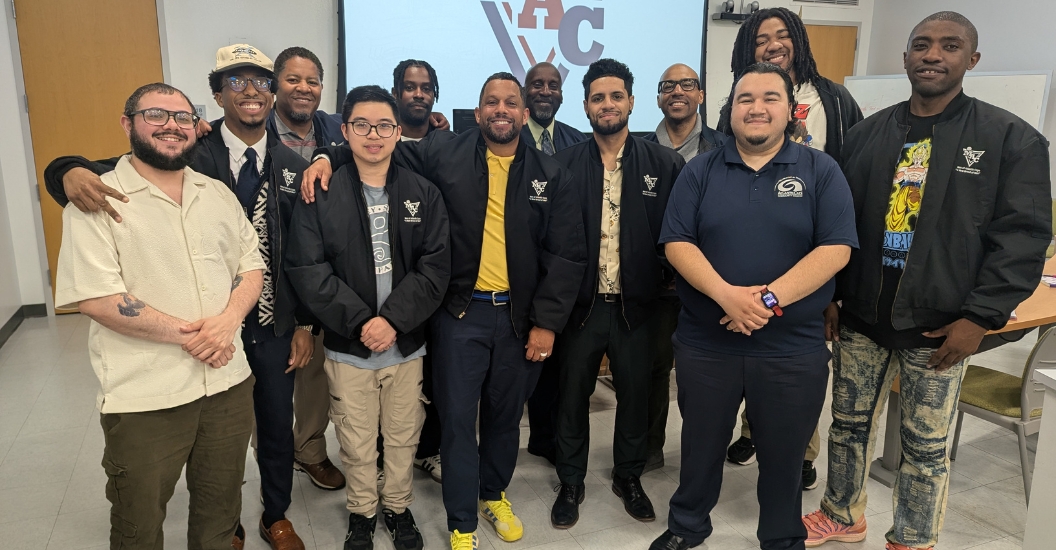
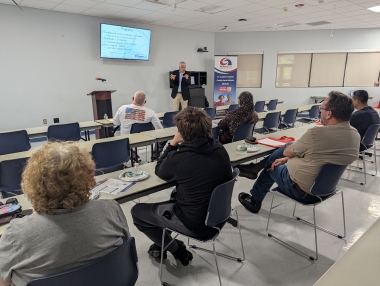 This open–to–the–public event brought guests of all ages and professional backgrounds to the College to learn more about a future with A.I. and drone technology at the forefront of all facets of people’s lives. The session was hosted by Dr. Otto Hernandez, department chair & professor, Computer Information Systems (CIS)/Information Systems and Aviation Studies (ISAS); Dr. Bojan Zilovic, professor, Computer Information Systems Management (CISM); Professor James Taggart and assistant professor, Business & Esports, Michele Togashi.
Atlantic Cape was awarded a $474,227 National Science Foundation (NSF) grant in June 2025 for its “Industry-Linked Artificial Intelligence and Machine Learning Pathways for Computer Programmers” project. This project will create a comprehensive associate degree and one-year certificate program that will increase access to A.I. technologies education for the College’s students throughout Atlantic and Cape May counties.
In August 2024, the College was awarded a $551,818 grant for its Preparing Small Unmanned Aircraft Systems (sUAS) Data Technicians project by the National Science Foundation. The project emphasizes instrument training for advanced sensors, including light detection ranging (lidar), laser methane detector, ground penetrating radar, real-time kinetic global positioning systems, infrared, and hyperspectral imagers (HSI).
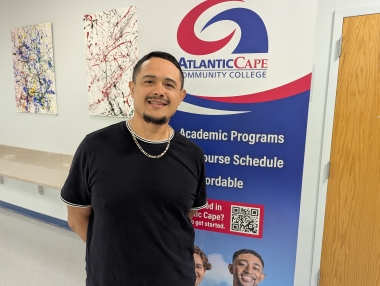 Atlantic Cape Class of 2007 alumnus Ivis Rios, who graduated with his Associate Degree in Business before earning a Bachelor’s Degree in International Business from Stockton University in 2010, has been employed for the past three years in logistics at the William J. Hughes Technical Center for Advanced Aerospace working in the laboratory with lab equipment, laptops and everything technical.
Rios, a native of Honduras who came to the United States when he was 11 years old and currently lives in Galloway, is interested in A.I. and drones as he has thoughts of transferring into a different career path at the technical center.
“I would like to learn more about A.I. and drones because it's a different world today that I don't know. Maybe learning about A.I. and drones can open doors for me in the future for jobs that would allow me to transfer to a different career at the tech center.”
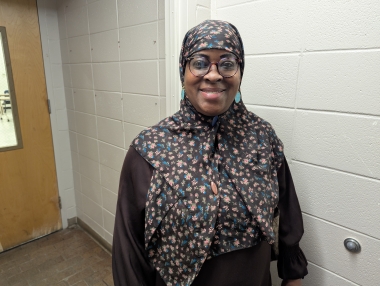 Atlantic City resident Yolanda Simms, who is a clinical supervisor with Recovery Centers of America in Mays Landing, earned her Master’s Degree in Counseling from Lincoln University. Simms is fascinated by the possibilities that A.I. holds, does not want to be left behind and is eager to learn more about it.
“I like to learn and I'm a self-taught kind of person. I've been doing some of the training and I've been sharing it with my family and friends for them to check out, and letting other people know that this (A.I.) is something that can help you. If you want to write a book or develop a business, this A.I. tool is really something find out about because it can be a benefit to you and your family,” said Simms.
Simms believes that A.I. technology may benefit her professional career.
“I believe that it (A.I.) can help me by assisting me in writing some programs and some curricula to help incoming students and professionals in the field to be able to perform their jobs more effectively.”
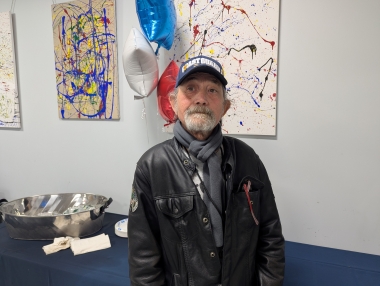 Ocean City resident and retiree George Critch spent his entire 50-year professional career out at sea working the maritime domain, unable to ever fully scratch the seaman’s life itch. Critch started out in the United States Coast Guard straight out of high school, then after four years of active duty, he decided to leave the land behind to become an offshore tugboat captain in New York Harbor where he earned the title of master operator.
Critch, despite a current physical ailment that he is determined to overcome, is interested in how drone technology may assist those working at sea so he may continue to impart his decades of knowledge and mentor the younger generation.
“There are drones now that are being used in the maritime domain helping to inspect tanks, unmanned and confined spaces that are dangerous. These drones can go in there and make assessments, and gauge if metal has to be changed or they can map areas too,” said Critch. “I want to impart wisdom upon others so they can be of service. I’ve always been a mentor and I would like to stay involved.”
Though he would be disappointed to see it, Critch believes that one day there will be remote controlled shipping vessels and, despite his trepidation, would love to be there to witness it.
“When it happens, maybe I could write the protocols and safety measures to maybe prevent it (accidents) from happening and inform those on why something is not safe. But I want to learn about it (A.I.) because it’s what is happening today. I try to stay away from it, but I have to understand it.”
For more information, please visit atlanticcape.edu/innovation.
###
About Atlantic Cape Community College
Established in 1964, Atlantic Cape Community College is a Middle States-accredited, Hispanic-serving institution proudly serving the residents of Atlantic and Cape May counties. As a comprehensive, two-year community college, Atlantic Cape offers more than 50 undergraduate degree programs and 34 certificate and workforce development professional series programs at its Mays Landing, Atlantic City, and Cape May campuses. Atlantic Cape is home to the renowned Academy of Culinary Arts, rated the top culinary school in New Jersey, and to its highly acclaimed Nursing program for more than 60 years. Atlantic Cape also partners with more than 30 colleges and four-year universities to offer students the opportunity to seamlessly earn a bachelor’s degree upon graduation.