
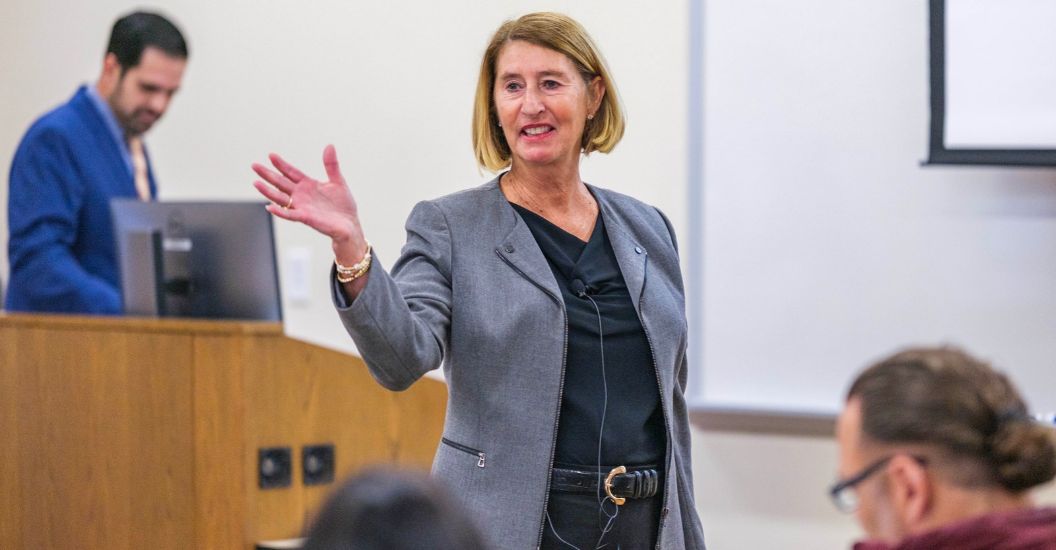
MAYS LANDING – Atlantic Cape Community College welcomed more than 50 local and regional healthcare, workforce, community, lower and higher education professionals to the College’s Mays Landing campus on November 20 to the inaugural Healthcare Summit for an interactive and collaborative discussion about the future of healthcare in the region.
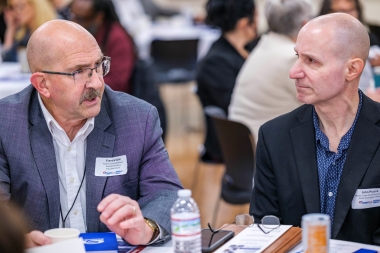 Those in attendance engaged in working sessions - debating and answering three questions on the current state of healthcare education at the College, the future of healthcare and recognizing the gaps that need attention - with others seated at their respective tables. Each free-flowing discussion brought forth myriad ideas and suggestions to identify gaps in the workforce, devise forward-thinking educational and training opportunities, while strengthening partnerships that support the healthcare industry and those it serves.
Since 1969, Atlantic Cape’s Associate in Applied Science (AAS) in Nursing program has awarded 3,432 degrees. In FY (fiscal year) 2026, 91 students completed the program, an 8.3% increase from FY2025 and a 16.7% jump from FY2024. Over the past five years, 430 AAS in Nursing degrees have been awarded.
During the past decade, comprising FY2017 through FY2026, 843 degrees have been conferred upon Atlantic Cape’s nursing students; representing on average 84 degrees annually and a 26% increase over the previous decade of fiscal years 2007 through 2016.
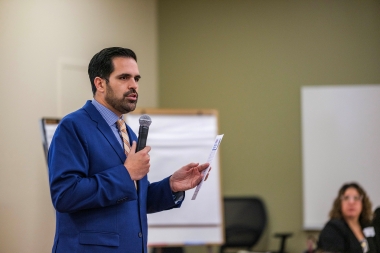 “This is exceptional! We must recognize that the impact of this work extends far beyond our students. It reaches our region, strengthens our communities, and, most importantly, creates opportunities that can transform families for generations. Many of our students are first-generation, while others are adult learners navigating significant personal, professional, and financial challenges. Their journeys remind us why this work matters,” said Atlantic Cape President Dr. Jason Abreu, the College’s 10th president in its 62-year history.
“As we look ahead, we must ask ourselves: How do we build the next 62 years of opportunity, access, and student success? More importantly, who will join us in that effort? This responsibility cannot rest with the College alone. Meaningful progress requires collaboration, shared commitment, and a collective belief in what is possible. No one achieves success entirely on their own, and our students should never have to navigate that journey without a strong network of support. Today's conversation is about bringing people together, strengthening partnerships, and building the momentum necessary to move Atlantic Cape forward. Ultimately, this is about our College, our region, and our community—but above all, it is about the students and families whose lives and futures we have the privilege to impact.”
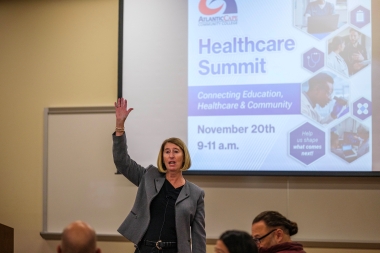 Lori Herndon, former CEO of AtlantiCare and founder of Herndon Bayside Health, served as the moderator for the Healthcare Summit. She believes that the collaboration between Atlantic Cape, AtlantiCare and all other local and regional healthcare providers is critical.
“It's an incredible responsibility and opportunity to build the healthcare workforce of the future. The college cannot do it by itself, so I applaud the leaders here for taking time out of their very busy schedules to bring this group together, hear from leaders in the healthcare field and to hear what they have to say.”
First-Generation Atlantic Cape nursing student Miguelangel Orellana (below left) and health sciences student Anthony Marroquin (below right) spoke about how important it is for them to be receiving an Atlantic Cape education as they strive towards their professional career goals in healthcare.
“I really love the smaller professor to student ratio here because it really aids in my learning and it also gives the students an opportunity to create a relationship with the professors so they can get advice on how to converse with professionals in the field that they are pursuing,” said Orellana, who is in his final year of the nursing program, serves as class representative for his cohort and is a Student Government Association (SGA) representative for the Nursing Club. “By attending Atlantic Cape, thanks to its tuition rate, just out of school the first year, half a year even, you make that investment back on your education. A majority these hospitals that Atlantic Cape works so closely with will pay for you to further your education. I feel it really gives our students a leg up on other colleges.”
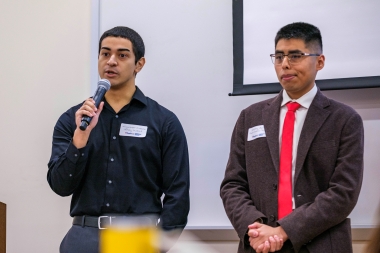 During Marroquin’s first two semesters he was enlisted in the Army National Guard. After being away for six months he found it difficult to return to Atlantic Cape and struggled.
“When I came back from the Guard I really couldn’t adapt. When I walk around campus, I see so many students working and trying to balance their life. So many students have to make a decision either to focus on college or support their family, and it's hard. I know for me I have to balance the military life with college and I have to help my family pay bills. It's rough,” said Marroquin, who currently works as a receptionist at Cooper Norcross Hospital in Cape May Court House. “I've met so many nursing students who are first-generation too. I interact with so many patients and helping them every day is hard work, but I love helping people.”
Herndon spoke of the challenges that the next generation of students today in healthcare are being tasked to learn so they may help the patients of tomorrow.
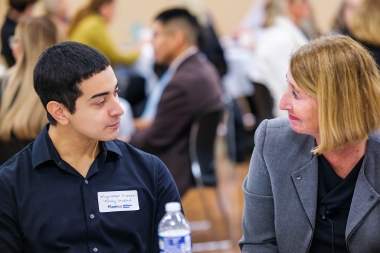 “Some of the challenges with the student populations today are so connected to their technology. They haven't been as connected to the altruistic opportunities of helping others and being more engaged. There's a concern that there's a little bit of a gap as well with the communication opportunities. When you are personally there for patients, you're a part of helping the healing journey. To navigate that we are going to have to do things differently to be able to get over some of those communication challenges,” said Herndon.
Complicating the challenges that students face today is the explosion of advanced technologies, particularly with artificial intelligence. Herndon admits it will become more critical for professionals in the healthcare industry to learn more personal skills, such as interacting personally and emotionally with a patient and not solely depending upon technology.
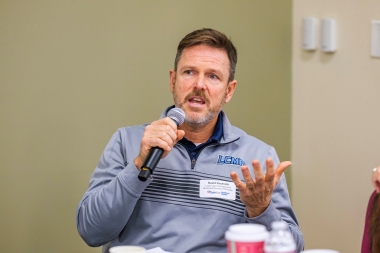 “Care that is required by humans is so personal and different from every patient. I love AI and I think it's going to really make a lot of things easier, but the challenge is we're still going to need people to help patients. It is a people business and it will always be a people business,” said Herndon. “I think the future leaders are going to have to really understand how tech and AI is going to run parallel to the human side of healthcare. You have to maintain that empathy with the patients. I'm excited about what the future holds. I think the work that is going on in education is preparing the students to have those critical thinking skills and be, and then of course not losing the human touch in the healthcare field.”
View a photo gallery of this event on Flickr here.
Visit atlanticcape.edu/nursing for more information on Atlantic Cape’s nursing and health science programs.
###
About Atlantic Cape Community College
Established in 1964, Atlantic Cape Community College is a Middle States-accredited, Hispanic-serving institution proudly serving the residents of Atlantic and Cape May counties. As a comprehensive, two-year community college, Atlantic Cape offers more than 50 undergraduate degree programs and 33 certificate and workforce development professional series programs at its Mays Landing, Atlantic City, and Cape May campuses. Atlantic Cape is home to the renowned Academy of Culinary Arts, rated the top culinary school in New Jersey, and to its highly acclaimed Nursing program for more than 60 years. Atlantic Cape also partners with more than 30 colleges and four-year universities to offer students the opportunity to seamlessly earn a bachelor’s degree upon graduation.